
How can scars cause pain?
As a teacher of Sharon Wheeler’s ScarWork globally, I have seen a lot of scars! And I have met a lot of people in anything from mild to acute pain. You see, when we run ScarWork classes, we invite ‘scar models’ to join us and receive free work from the supervised students. Many hundreds of people have walked through the doors over the twelve years I’ve been teaching, and they have almost invariably been pleased with the care our students have given them. Many report lowered pain levels as well as the expected improvement in gait, posture and mobility.
Why would this be?
Scars are the natural result of tissue healing after surgery, injury, self-harm, etc.; in fact, anything that cuts through the skin. With its protective surround compromised, the body goes into emergency mode, triggering the response that we are all familiar with. The scar may heal really well, and we feel content that our body has done its job and the result is not unsightly. Or, perhaps the scar is rather ugly and we feel self-conscious about it. How we feel about our scar is really important as it can affect what we wear, our self-confidence and our relationships, for example. This blog, however, is focusing on the physical aspect of scarring; it’s all about what lies beneath…..
The fascia is one of the body’s connective tissues, but it is so much more. It connects every structure, defines and separates the compartments (e.g. the thorax and pelvis) of the body, outlines every organ, blood vessel, nerve, etc. within us and, amongst many other roles, creates a tangible connection from top to toe, back to front, skin to deep tissue. Scars usually disrupt that fascial continuity; the tension created by the healing process can and will pull tissues and even joints out of alignment. They can also cause pressure on and displacement of nerves. They may cause accumulation of fluid (oedema) where the fascial planes become stuck together. These and other effects of ‘stuck’ fascia can lead to pain, mild or severe, acute or chronic.
The photos below are an illustration of an analogy I give to my students to show how a scar (the hand gripping the material) can distort the fascia, and then (2nd photo) how another scar or area of damaged tissue may feed intothat point creating even more distortion. Then think of this happening three dimensionally, so perhaps a laparoscopy on the abdomen and an epidural on the lumbar spine; the scars appear to connect through the body as well as linearly. This is our empirical experience; the research yet has to catch up with us.
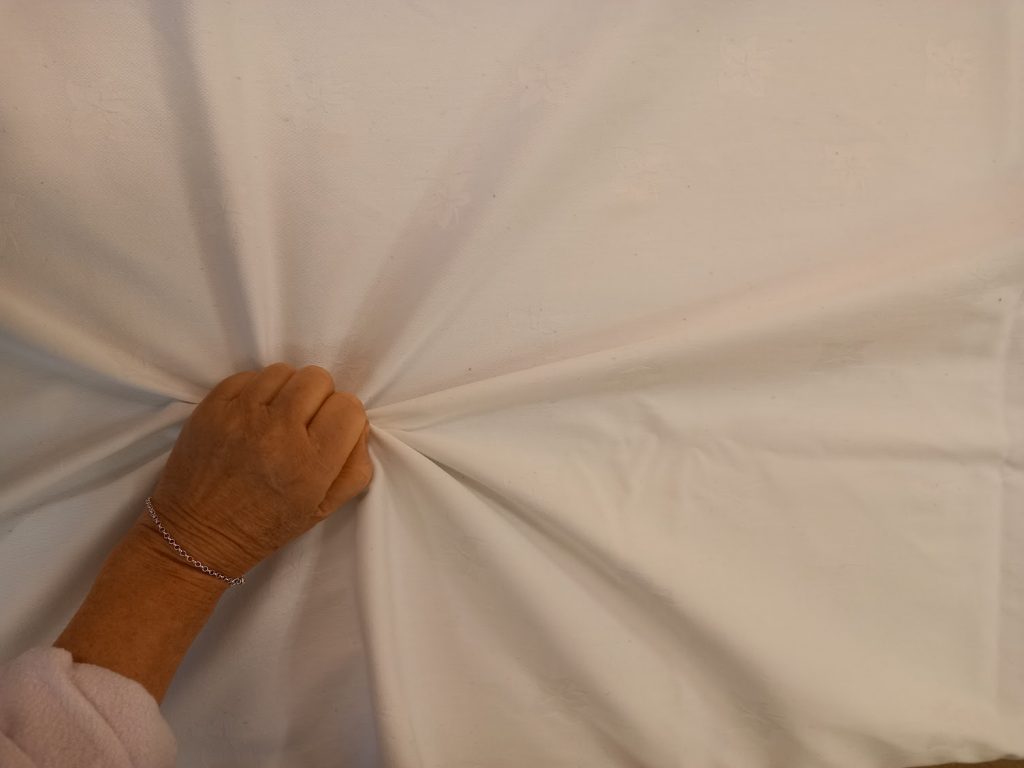
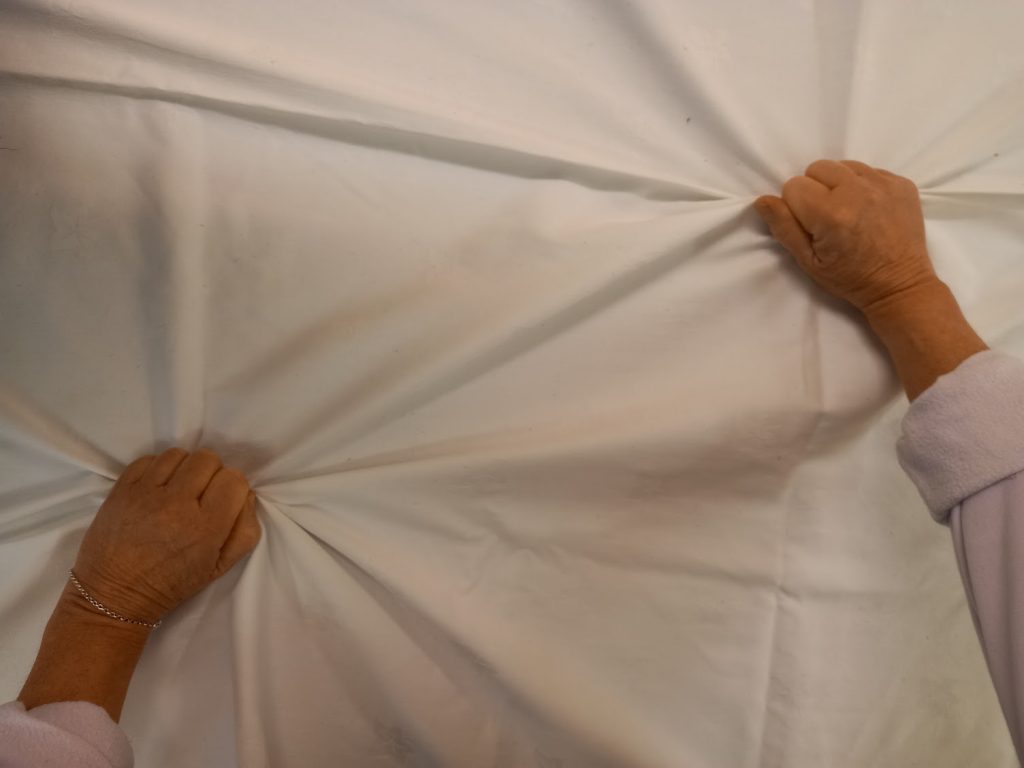
When we work on scars we are normally able to release the tension in them and that cascades through the fascia, often lessening the compressive effect on the nerves and alleviating pain. As the structural imbalance corrects internally, gait and posture, as well as mobility and functionality usually correct (as long as all the scars have been addressed as even one scar still in its tense state may still exert a strong enough pull to maintain that imbalance).
It is always worth having all one’s scars worked on and I can only recommend Sharon Wheeler’s ScarWork. There is a directory of ScarWork therapists here. Currently only the UK and USA are included, but this will eventually incorporate a global list. You can always Google a therapist local to you, but make sure they are practising a recognised and recommended technique, not just ‘scar massage’; scars require a different approach to massage if optimum results are to be achieved.
Want to know more about pain? With my other ‘hat’ on, I am Director of The Fascia Hub. On 27/28 June (2026) we are running a full weekend focusing on pain. Even if you are reading this past that date, there will be the possibility of buying a ticket and watching the replay until 20 September. After that it will be uploaded to the Members’ Area for free, longterm access to our members. Find out more about membership here.